Archive for the ‘Homebrew’ Category

McKenzie’s Results

Monday, March 8th, 2010

So yesterday McKenzie’s Brew House announced the winner to their little homebrew competition they recently had.

The competition was pretty quiet from what I can tell, I can’t even remember where I heard about it. But the entry deadline was February 15th and the only real criteria was the beer had to be described as “Belgian”. “Out of style” Belgian Specialty ales were highly encouraged. From the impression I got there were maybe 20 entries, like I said pretty small.

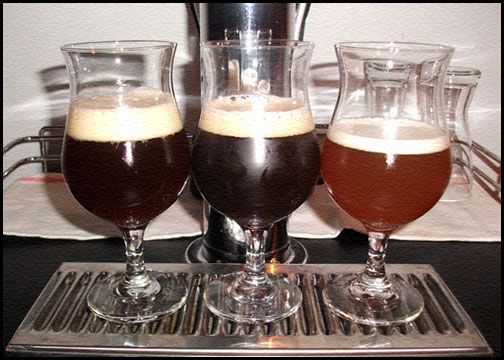
I decided to enter my Chinese 5-Spice Infused Belgian-style Dubbel, AKA Chinese Dubbel, AKA Dubbel Dragon (thanks Erik). I figured the base beer was good enough to hang, the 5-Spice contribution was definitely “out of style”, and the beer itself is actually pretty good. Now that I’ve had a few to drink it reminds me of a cross between a Winter Warmer and a Belgian Dubbel, makes sense to me. The beer also starts off very well balance, yes spicy but not overwhelming, though as the beer warms the spices do come to the forefront.

So yesterday, Sunday 03.07.10, McKenzie’s had a small get together/thank you for the brewers that entered and they were going to announce the winners. It was suppose to start at 4 and started just after. They had all of the house beers, plus the regular seasonals, plus they had their award winning Saison available plus a barrel-fermented (not barrel aged) version of the Saison too, there had a little bit of Heywood-toe up in that beer ;) . On top of that they also put out a spread with appetizers; wings, hummus, bbq beef – it was nice.

So, I’ll say I didn’t place now, though they did announce a top three winners, even though they had only mentioned there was going to be a first place. The winners were a Dubbel, a Tripel, and a Belgian Strong Ale which took first. Not that I’m complaining, I’m just pointing out the lack of “out of style”-ness of the winners. The very cool part was the winning brewer and recipe will get to be brewed on McKenzie’s system, nice.

I’ll wrap this up with some notes from the judges, honestly only pretty good stuff to say, but anyway here we go:

  • Judge 1 “Alcohol is well hidden and base beer seems beautifully executed, but it’s hard to tell with all of the spice character.”
  • Judge 2 “Great base beer, very well made. Yeast fruit and spice marry well with carmely vanilla like malt character. For me, the spices add great complexity, but tend to dominate a bit too much.”

Kegging & Brewing

Tuesday, March 2nd, 2010

Sunday was productive enough in my little world of homebrewing; kegged the Pale Ales, did some house-keeping, and brewed an Amber Ale.

So of course the highlight is the Amber Ale. I jokingly called it the Anxious Amber because I am so concerned with running out of beer / not having three beers on tap. What’s the point of having three taps if they’re all not full, right? So this is a pretty straight forward Amber, sort of similar malt bill as my California Red but toned down a notch, and a little wacky-bird hop experiment using only traditional bittering hops throughout, Magnum and Chinook – I bet it’ll be great. The Magnums were some sticky fellows, even after washing my hands there was still some tackiness.

The brew day itself went pretty well, no major hic-cups. Still a little perturbed at the extended mashes and extended cool downs after jumping up to 10 gallon batches, thus extending my day over all. It takes me about 80-90 minutes to heat up all of my sparge and mash-out water, which is about 30 minutes longer than I would care to mash. Though, I must say, the last few batches have crushed the efficiencies, like by more than 0.010 points, so maybe there is at least some benefit to the extended mash. The cooling has and always will drive me nuts. I honestly believe a double cycle through a plate chiller would be the way to go. Maybe even whirlpool back into the kettle while pumping to help the trub collect in the middle, let it settle some, and the crack the valve and syphon clean cool wort … hmmm maybe after I have money to blow on homebrew crap again.

Other than that the day was pretty chilled. Transferred the two Pale Ales to kegs and did a bunch of house-keeping. Cleaned up my general work area, cleaned like five carboys, and like two kegs. Hey, you gotta do what you gotta do to keep the beer flowing for these knuckleheads. Speaking of beer flowing, the Chinese 5-Spice Belgian Dubbel-style beer (thus has been dubbed the Chinese Dubbel) has definitely been a crown-pleaser and I am totally down with that.

War of the Worts XV

Sunday, February 21st, 2010

The War of the Worts (WOTW) XV homebrew competition was yesterday, Saturday 02.20.10, and it was good times indeed.

With 816 entries in this years WOTW competition this was big! You can check out all the results here – RESULTS. It had been quite a while since I judged at a competition, maybe 6-8 months, but I was hyped to get into it. In the morning I was able to judge the Specialty Beer category with 44 entries and 8 judges, so about 11 entries per pair. The Specialty Beer category is kind of the catch-all for beers that don’t fall into other categories: experimental techniques, historical, style-bending, and total odd-balls. I actually really enjoy judging this category, there are a lot of mediocre beers that wind up here, but there are some that are kind of inspirational that help you formulate your own ideas. I believe the top three that moved on were an American Wild Ale (spontaneously fermented in the LeHigh Valley, haha), a Gruit (beer made without hops but with herbs to supply the bitterness), and an Imperial Pilsner. We probably started around 9:00 and wrapped the first round at a little after 12:00, not too bad.

Iron Hill Brewery then generously supplied us with lunch, two different tossed salads and a combo of sicilian-style pizza and wood-oven pizza. I think the IH crew wasn’t anticipating how much judges like to eat free food, they were having a hard time staying on top of our consumption of mass quantities, but it was all good an no one didn’t have enough to eat. After lunch I was able to judge Wood-Aged and Smoked Beers. Sounds like an interesting category, but I’ll tell you what, it is a palate destroyer, I’m not sure I’d want to judge that one again. This time there were 33 entries I think with 8 judges again, so it should have been about 8 beers per pair, my partner and I judge very similarly and we were able to do 13 beers in the afternoon. The best beer we had was a great IPA aged on cedar. I really wish I knew more of what the cedar was suppose to contribute because I’m afraid it didn’t fair as well as it could have if we had a descriptor to reference to see what cedar contributions were suppose to be like. It tasted like an awesome hoppy shortbread cookie or something, I really dug it. I think the top three were an Oaked Old Ale, a Smoked Porter, and a Smoked something-something. The Smoked Porter was bacon-esque while the Smoked something-something was more camp fire-esque, interesting.

I also had two beers entered in this competition, actually, I had the same beer entered twice, shotgun approach. This was the Fool Circle 10th Anniversary Beer, the Stick-Icky DIPA, which has recently been dubbed the FCX, got all that. Anyway, I entered it as an American IPA and as a Imperial IPA. The theory being I think it is better suited as a DIPA, but sometimes a “big beer” will fair better in a smaller category because it stands out against the other, so I was hoping for the extra pop in the AIPA category. Here’s some of what the judges had to say below:

  • American IPA – Judge 1: 33/50, Judge 2: 37/50, Average: 35 – Very Good
  • Judge 1: Almost flat, sticky resiny pungent hops with some caramel and alcohol, tasted like it really would have “popped” if not for lack of carbonation.
  • Judge 2: Low carbonation, very hoppy – nice balance of citrusy, piney, and grapefruit, good example of an Am IPA on the edge of a IIPA.
  • Imperial IPA – Judge 1: 34/50, Judge 2: 32/50, Average: 33 – Very Good
  • Judge 1: Good Imperial IPA, citrus and pine, almost grape like aroma, plum and stone-fruit in flavor, very good attempt at style.
  • Judge 2: May be too estery for style, hop flavor is definitely present, other flavors include watermelon, grape, and lemon from hops and esters.

So there you go, unbiased “professional” opinions of my beer. I really don’t like arguing with what the judges say because, well, I want to respect their opinions as much as I want mine respected, but I also know how the process works and sometimes a good beer can get brushed to the side just because the judge is trying to judge it <- I don’t even know if that made sense, haha. Looks like there were 41 AIPAs in the competition and 25 English/and Imperial IPAs. I think the one thing that bothers me most is the carbonation comments from the AIPA judges. I know the beer was well carbonated, I actually just had a bottle from the same batch the other day, so it makes me think they received a “bad bottle” for some reason, like perhaps the cap wasn’t set correctly when I bottled it and then through time and shipping the carbonation level dropped, dunno, but it tweaks me a little bit. Really would have liked to place, especially in such a big competition, but alas I didn’t, oh well. Good feedback is always good on it’s own.

Pushing Beer

Sunday, February 14th, 2010

So this evening was spent pushing beer from one container to another.

First, the Twenty Pound Pale Ale had to be moved from the primary fermenter to the secondary and get a dose of dry hops, 1 oz of Centennial to be exact. I also moved the beer from upstairs to downstairs where the warmer temp upstairs is preferable during this time of the year to help with primary fermentation, the cooler temperatures downstairs will benefit the beer clarifying. It weighed in at roughly 5.5% alcohol, and pretty balanced, yet slightly malty as of now, so the dry hops should move it towards very balanced. Most of my pale ales are aggressively hopped, this one, not so much.

Next the Dubbel and the Chinese 5-Spice Dubbel needed to be bottled. I pulled 5 bottles of the Dubbel and 9 bottles of the 5-Spice, kind of weird numbers now that I think of it. I’m going to leave one of these on tap for now, not sure which, but I am leaning toward the traditional Belgian-style Dubbel, and the other I am going to reserve. I was thinking about it earlier, it’s been since like Christmas since I have had 3 beers on tap at once, I need to remedy this. So I’ll reserve one of the Dubbels, then the Pale Ale will be ready to roll in like two weeks, but that’s it. So I guess I’ll need to brew again soon, and often. If things go right I’ll be re-upping on base malt shortly so it’ll be time to get my brew on, anyone have any suggestions, I’m open!

Hop Bomb

Monday, February 8th, 2010

Twelve ounces IPA plus one ounce Hop Vodka equals a HOP BOMB!

So for this example, the first example I am aware of anywhere, we used Dogfish Head 60 Minute IPA and the Hop Vodka I created, which was Three Olives plain vodka infused with Cascade hops. Originally we were thinking of drinking it a la Car Bomb style, drop the shot and chug, but we thought otherwise, and probably for the better. So instead, Robert and I drank it more Boiler Maker style, pour the Hop Vodka into the IPA, thus a Hop Vodka Infused IPA. The Hop Vodka definitely brought a new level of hop “freshness” to the beer, slightly like when DFH pours there beer through a Randall but a little more grassy/green in flavor. Overall it was pretty good, and if I try to refine the Hop Vodka like I mentioned it may be really good. I’ll have to experiment with this. But remember, you heard it here first, it’s called a Hop Bomb!

Also, yesterday I transferred the Dubbel and the Chinese 5-Spice Dubbel to kegs and started carbonating them. The Dubbel tasted fine, which is good, but what I was really interested in was trying the 5-Spice Dubbel. You could definitely pick-up on the spice aspect in the nose, in particularly the cinnamon, which had me concerned. I’ve used cinnamon in batches before where it just blew out everything else. Also in the blend that I used was: cinnamon, anise, fennel, ginger, clove, and licorice root. Yes, I know there are six spices listed, my guess is the manufacturer used both anise and licorice root to compliment the same flavor and give it depth at the same time. Upon first taste I was pleasantly surprised; the spices weren’t too overwhelming, but you could tell they were there. It was sort of like a cross between a mellow not-to-boozy Winter Warmer and Belgian-style Dubbel. There was a cool dessert note to it too, I think accentuated by the ginger and clove, kind of like a ginger snap, made me wish I used molasses in the batch. So, first impressions I wasn’t disappointed at all, can’t wait to have a full glass of this puppy when it’s fully carbonated and chilled out.

Hop Vodka

Thursday, February 4th, 2010

Sometimes things that seem like a good idea really aren’t, and sometimes things that seem like a bad idea really aren’t either. I haven’t decided if this is a good idea or a bad idea yet, or even if it was successful or unsuccessful.

So while creating the Chinese 5 Spice infused vodka for the Chinese 5 Spice Belgian Dubbel I decided I was going to mess around with making a Hop Vodka also. Originally I had contacted the distiller at Dogfish Head Brewery to get her advice on what kind of proportions were necessary, how to filter, and if they had ever tried it. She responded that they have never tried a Chinese 5 Spice vodka, but had tried a Hop Vodka without too much success. Her advice was two handfuls (she guessed 2oz) of whole leaf hops to 750ml of vodka. Let soak for 48 hours then strain, then filter through charcoal (like a Brita filter). She said with their experiment it was still too strong and they then cut the infused vodka with 750ml of plain vodka, so really 1oz to 750ml.

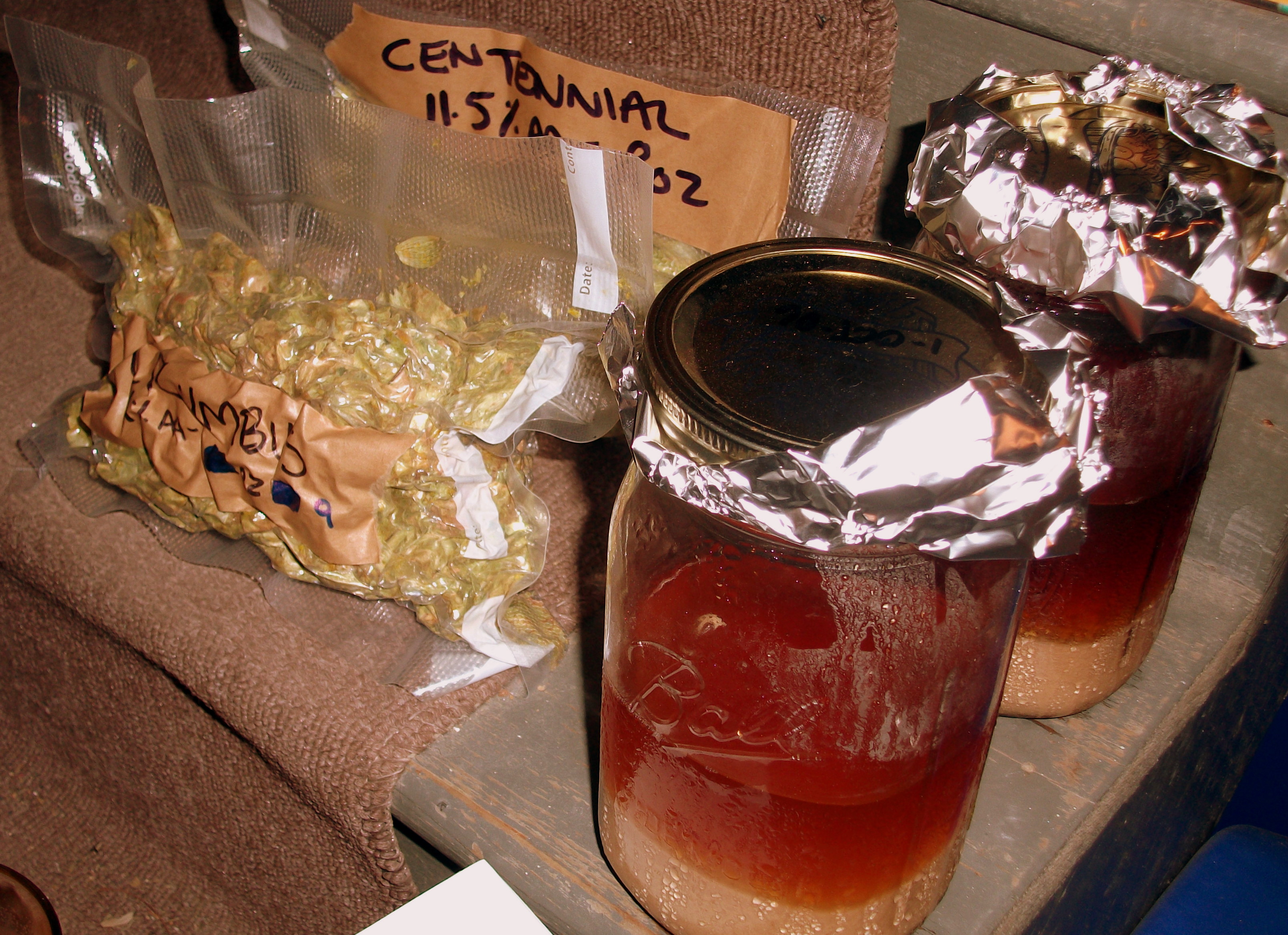
So for my experiment I used 1oz of Cascade whole leaf hops to 375ml of vodka. I let this soak for 48 hours giving it a shake whenever I happened to walk by. I then inverted the jar and strained the hops out through the vodka for 24 hours. After that time there was just over 200ml of hop infused vodka, where’d the other 150ml go, I’m not sure I guess the hops drank it. The Hop Vodka is a bizarre bright yellow/orange and smells very much of hops, but also with a grassy tone to it. The flavor is, … intense! It covers all aspects of the hop, bitterness, flavor, and aroma, plus the grassy/green/flowery type thing. And of course it’s vodka, so it’s hot, well, at least to me.

So far now I’m not sure if I like it, it’s big. I think if (when) I do it again I’ll use a higher vodka to hops ratio, like 1oz to 750ml, and/or let the hops sit on the vodka for a shorter time frame, like 24 hours instead. So what’s next? I think Hop Bombs are next, think a Boiler Maker but with Hop Vodka and DFH 60 Minute IPA! I think I just made myself a little excited :)

Twenty Pound Pale Ale

Monday, February 1st, 2010

I am in desperate need to buy more ingredients, so in the mean time, I’ll improvised!

So this is it … until I buy more ingredients no more beer will be made, it’s a sad day indeed. So basically I was down to twenty pounds of base malt, an ass ton of American hops, and some dry English yeast. So what did I make? Hell if I know, a Twenty Pound Pale Ale, that’s my story and I’m sticking to it. It’ll be good, and you’ll like it, trust me. So basically I took all the base malt and mashed real low to make it nice and fermentable, dropped three hop additions with a fourth reserved for dry hopping, and set the little English buggers loose on it. That was yesterday. Cold as hell, but at least the snow had stopped. That was pretty much the second day in a row of spending too much time outside when it is way too cold, I couldn’t get warm last night, suckage.

Oh BTW, the last half a keg of the Fool Circle 10th Anniversary Ale is now on tap, ask nicely and I might share. Might.

Also, watch out for Hop Vodka. Yup.

Dubbel – Revisited

Sunday, January 31st, 2010

So I’ve messed around with the Belgian Dubbel style ale a little bit, so I figured it’s time to keep the “world” updated.

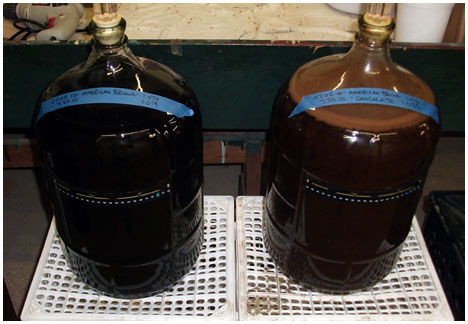
So last Saturday I transferred the two carboys of Dubbel to secondaries. Everything went as well as possible, except for one exception, I dosed one of the secondaries. Yup, dosed it with Chinese 5-Spice Infused Vodka, and that shit was potent! Seriously, I used 375ml of Three Olives vodka to 1oz by weight of ground Chinese 5-Spice. I then let this sit for 48 hours, swirling the jar whenever I happen to walk by. After 48 hours I double filtered it through a coffee filter, once and then again. If I was feeling really ambitious I would have put it through a Brita filter or another charcoal filter, charcoal is a distillers best friend as it’s said, but I didn’t want to “ruin” a filter with eternal 5-Spice flavor. Regardless, the stuff was like mace just smelling it, and like an 1/8th of a shot was pretty intense – so I was pleased :) . Basically I was looking for a solution to extract the 5-Spice flavor and to be able to add the least amount of solution to the brew.

I pulled 32oz during the transfer to experiment on intensity. I added 1/4 tsp to a pint at a time until I thought I reached a flavor threshold that was somewhere between “yeah I can tell it is there, and what’s different about this beer…?” So subtle, but not non-existent. This turned out to be approximately 1 tsp per pint. Quick math told me I had 40 pints in this batch, thus 40 tsps, which turns out to be roughly 6.5oz of solution – so that’s what I added. It’s been in secondary for a week now and looks very similar to the un-flavored batch, cool.

Originally I was going to keg both of these batched next Saturday (02.06), but I’d like to enter it in a competition where entreis are due by this Sunday which means I’d need to keg it closer to Monday or Tuesday to leave time for carbonation, refridgeration, bottling, and shipping … poop. We’ll see what happens, maybe I’ll skip the deadline.

Dubbel

Sunday, January 10th, 2010

Yesterday was the first brew day of 2010, and so far so good!

I brewed a 10 gallon batch of a Belgian-style Dubbel. Originally I was suppose to do this last week, but one key ingredient I was waiting on, Belgian Candi Syrup, had not arrived yet, so it was postponed until yesterday. It really is a shame that the local homebrew supply store does not carry this product for I feel as if there is no comparison, rock candy or the newer soft candy sugar. The reasoning was supposedly because it was too expensive, though I was willing to pay a premium price plus shipping to try and have it in time and still was not able to, disappointing.

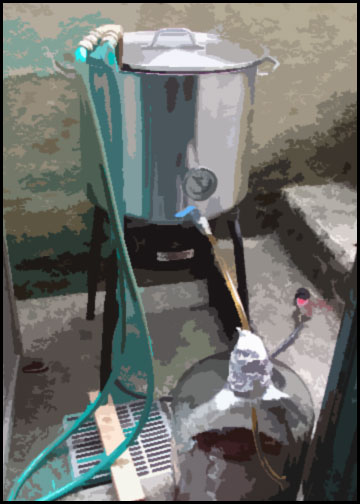
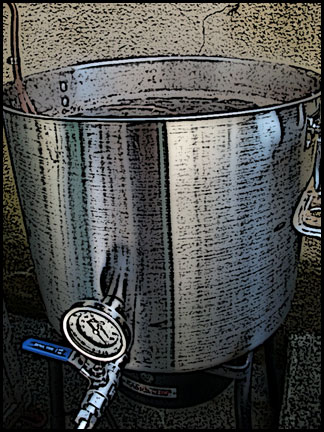
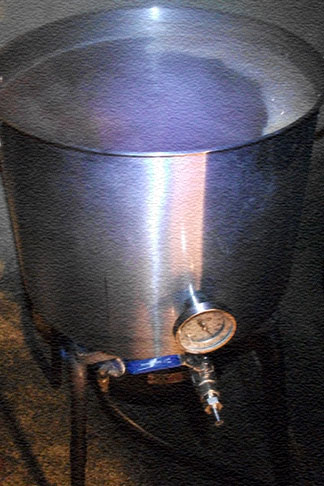
Regardless, the brew day went relatively well after it got started. My typical starting time is 10AM which has me wrapping up by 5PM typically. Yesterday I just could not get going in the morning so the day didn’t start until 12PM and I didn’t wrap until 7PM. I have noticed that 10 gallon batches do take slightly longer than a 5 gallon batch, and the problem seems to be that I can’t heat my water fast enough, I suppose the quantity is just that much greater. For example, after I mashed in I began heating the water right away for the mash out water and sparge water, about 14 gallons total. It took 1 hour and 50 minutes to bring 10 gallons up to 170′F and the other 4 gallons up to 212′F, that’s 50 minutes longer than I would have preferred my mash rest to be. And lets not forget the heating of the foundation water, bringing the wort back to a boil, and my favorite cooling the wort to pitching temperature – which for once was a non-issue (thank you January freezing cold ground water!). One option is a more powerful burner for the burner stand, I believe mine is currently 75,000BTU and they really just go up from there, but so will propane consumption, which is already up with the larger batch sizes. Additionally, I think when the weather begins to warm it will be time for a wort chiller upgrade. I am currently leaning towards a counter-flow or plate chiller to help with time consumption, but the “new” immersion/whirlpool options seem pretty interesting too, we’ll have to see what time and money allows.

I was able to use the newly converted mash tun for the first time this batch, it went well. No leaks, and I only smacked the thermometer a few times. It was also more likely a better temperature ready too, the new thermometer is much closer to being in the middle of the tun which is most likely a better average of the overall temperature, versus before I used a digital thermometer on the surface (first 6 inches or so) of the tun, which always worked, but I always questioned it’s overall performance.

So currently there is 10 gallons of Dubbel popping away in my upstairs where it is warmer. I plan on leaving 5 gallons of this beer traditional and the other 5 gallons I plan on doing something. Currently I am leaning towards dry-spicing the beer of making a spice-neutral spirit (vodka) infusion and infusing the beer in secondary. I think I want to do a Chinese 5 Spice Dubbel. If I’m luck the spice and yeast profile and malt aspect of the beer will go together brilliantly, if I’m not so lucky I may have a lot of spicy cooking solution. Though I am a week off from my original brew date, I am aiming to have these beers wrap up quickly if all goes well. There are two homebrew competitions that are coming up in February that I’d like to enter these, and it’s been a while since I entered a competition. First is the War of the Worts XV which is February 20th but entries have to be received by the 7th, but if I judge (which I plan to) I may be able to bring them the day of the competition as long as they are already registered, which will buy my an extra 2 weeks. The second is a homebrew competition through McKenzie’s Brew House, which is a Belgian competition only, which need to be in by February 15th. This one is interesting for the winner gets have their recipe brewed on the McKenzie’s system and served at the pub, nice!

Oh, and just to keep you posted, the Fool Circle 10th Anniversary Stick-Icky DIPA was kegged yesterday, so theoretically it’ll be on tap by next weekend, very good news. It tasted delicious and smelt fantastic while kegging. Though I learned a lesson, removing 12oz of spent dry hops (read: wet hops) from a carboy sucks! I have not found an easy way yet to get all that hoppy goodness out of that little hole in an easy manner, oh well, it’s worth it! Though I was thinking, I wonder if there is a way to create a device or system that will keep the dry hops constantly moving in the fermenter? The reason I wonder is that I’ve always noticed that the dry hops float on top of the wort, after they are wetted they are immersed in the wort, but still at the top. It makes me wonder if the hops were constantly moving throughout the wort, thus creating an ever changing contact point between hop (lupilin) and wort would there be an increased efficiency. Maybe some way to bubble CO2 through the solution to create an environment that would force movement, or a very big and strong stir plate that would constantly swirl the solution … dunno, just thinking aloud.

You got salad in my beer!

Sunday, December 20th, 2009

You got beer in my salad! … Or something like that, either you get it or you don’t ;)

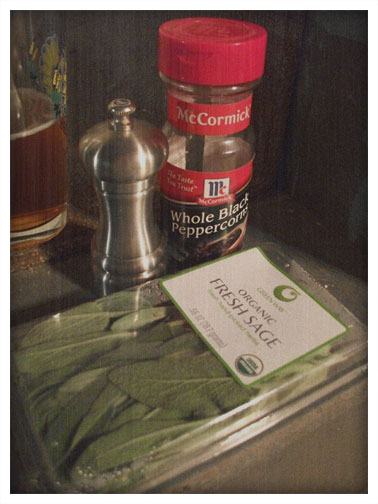
salad in my beer

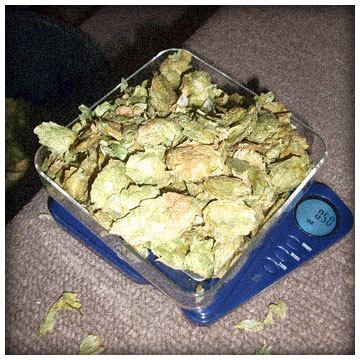
So yesterday I finally had the opportunity to transfer the Anniversary Ale into secondary carboys and to add the dry hops. Let me be the first to say: 6oz of dry hops in 5 gallons of beer is totally and completely unnecessary and absolutely overboard. OK, now someone has said it, and I agree. BUT I did it anyway and it makes me smile.

When I was getting ready to add the dry hops I realized this is going to be a huge amount of hops, it filled about a gallon of space in the carboy, so my typical 5 gallon secondary carboys were not going to work, so I had to use my 6.5 primary carboys for this experiment. As of right now I would say only about a 1/4 of the hops are actually wetted, but I plan on leaving them in for three weeks, so I ‘ll give them a week on there own to absorb. But if it appears as if it it just too much, well then I guess I’ll flush the head space with CO2 and then give the beer an nice swirl or shake or something to get them as wetted as possible. No need to be wasteful in an already lushy environment.

The bad news was when I transfer the beer I always take a second gravity reading, the beer was still in the mid-1.020’s, not really what I was looking for. It wasn’t excessively sweet, but it had a lot more “chew” to it then I was looking for which for me lowers it drinkability (is this Bud Light?). I was thinking more West Coast style IPA, now we’re looking at more of an East Coast style, a la 90 Minute IPA from DFH. And I’m talking about body and fullness, not flavor as of now. I suppose that’s the flip side to Summer brewing is Winter brewing. In Summer it’s a constant battle to try and keep fermentation temperatures low, in the Winter trying to keep them high enough. It did ferment around 67/68F for the first week, but was probably closer to 63/64F for the second, and then fell close to 60F for the third. Oh well. I guess it’s time to try and find the time and money to work on the fermentation cabinet that I have, which should be able to create a year round stable environment.

Also of brief note, the Harvest Ale is now on tap. This is the beer that Garrett and I brewed using only fresh hops. Literally from the vine to the kettle. I totally appreciated the opportunity to brew that beer since I would not have been able to do it on my own since I have not re-planted my hops in years. I know, bad hop daddy. The beer turned out great, very different flavor than most “hoppy” beers and a great silky/creamy texture I wasn’t expecting. The hops are more floral, spicy, earthy, mellow but still retain a fresh flavor. It’s been dubbed the Freshy-Fresh around here. So soon there will be the Freshy-Fresh and the Sticky-Icky on tap, too funny.